5 Tai Chi Exercises to Strengthen Your Legs and Improve Balance
 Peter Hoogduin

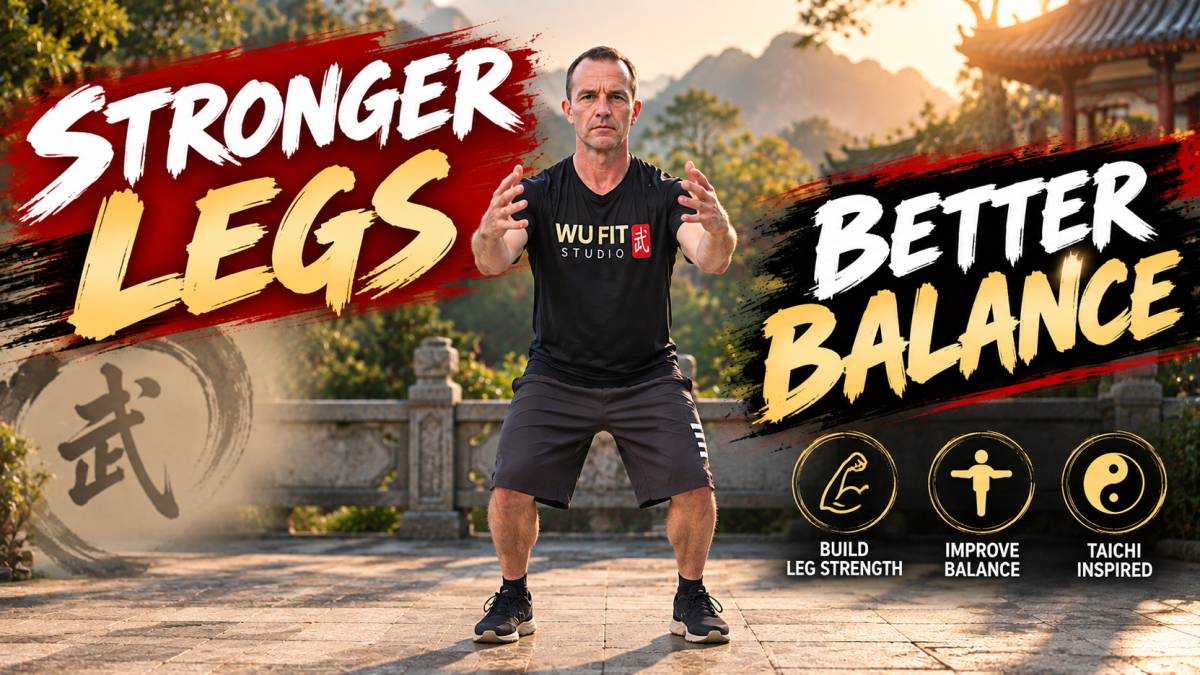
Discover 5 Tai Chi exercises to strengthen your legs, improve balance and develop better body control. Learn how slow, controlled movements can build strength, stability and coordination
5 Tai Chi Exercises to Strengthen Your Legs and Improve Balance
Discover how five Tai Chi exercises can help you build stronger legs, improve your balance and develop better body control — without heavy weights or exhausting workouts.
When we think about strengthening our legs, exercises like squats, lunges and weight training usually come to mind.
But did you know that Tai Chi can also be an effective way to challenge your leg muscles while improving balance, coordination and body awareness?
One of the things I love about Tai Chi is that it teaches us something we often forget during exercise: slower movements can sometimes be more challenging than faster ones.
Instead of relying on speed or momentum, Tai Chi encourages you to move with control, maintain your balance and relax unnecessary tension.
In this article, I'll introduce five Tai Chi exercises that can help strengthen your legs, improve stability and develop greater confidence in how your body moves.
And the best part? You don't need any previous Tai Chi or martial arts experience to get started.
Watch: 5 Tai Chi Exercises for Stronger Legs and Better Balance
I've put together a follow-along video demonstrating all five exercises, including beginner-friendly variations and suggestions for making the workout more challenging as you improve.
https://www.youtube.com/embed/N2CNRfyezvM
Prefer watching directly on YouTube?
▶ Watch the Full Tai Chi Leg Strengthening Workout on YouTube
You can also subscribe to the WU Fit Studio YouTube channel for more exercises and workouts focused on strength, mobility, flexibility and balance.
Can Tai Chi Really Strengthen Your Legs?
Yes. Tai Chi can help develop leg strength, muscular endurance and balance, particularly through slow, controlled movements and sustained positions.
Unlike traditional weight training, where you typically increase resistance by adding weight, Tai Chi often uses your own body weight to challenge your muscles.
For example, holding a slightly lowered position requires your leg muscles to remain active.
Slowly transferring your weight from one leg to another challenges the muscles responsible for keeping you stable.
And balancing on one leg requires coordination between your muscles and nervous system.
Regular Tai Chi practice can help improve:
- Leg strength and muscular endurance: Supporting your body weight through controlled movements and sustained positions.
- Balance and stability: Maintaining control as your body weight shifts between your legs.
- Coordination: Learning to move different parts of your body together smoothly.
- Body awareness: Becoming more conscious of your posture, weight distribution and movement.
- Relaxation: Learning to release unnecessary muscular tension while remaining physically active.
Tai Chi doesn't need to replace other forms of strength training. Instead, it can complement them by developing balance, control and movement quality.
Let's look at the five exercises.
1. Basic Static Tai Chi Pose — Build Leg Strength and Endurance
Insert screenshot of the static Tai Chi pose from your video.
The first exercise is a basic static Tai Chi pose.
At first glance, this might look like one of the easiest exercises in the workout because you're not moving very much.
But don't let that fool you!
Holding a slightly lowered position can become surprisingly demanding, especially when you maintain it for 20 or 30 seconds.
This is an example of an isometric exercise, where your muscles work to maintain a position without significant movement.
Benefits of the Basic Static Tai Chi Pose
Stronger legs: Your quadriceps and other supporting muscles work to maintain the position.
Improved muscular endurance: Holding the position challenges your muscles to sustain effort over time.
Better posture awareness: Because you're not moving, you can pay more attention to your body alignment and weight distribution.
Learning to relax: One of the most important lessons is that your legs can work hard while your shoulders, neck and upper body remain relaxed.
This last point is especially important.
Many people automatically tense their entire body when an exercise becomes challenging.
But Tai Chi teaches us to distinguish between the muscles that need to work and those that can remain relaxed.
Watch the Basic Static Tai Chi Pose at 0:12
2. Tai Chi Forward Step — Develop Leg Strength and Control
Insert screenshot of the Tai Chi forward step.
The Tai Chi forward step is an excellent exercise for developing leg strength, balance and controlled weight transfer.
Walking is something we do every day without thinking much about it.
But when you slow down a stepping movement, you begin to notice just how much muscular control is required.
Instead of using momentum to carry your body forward, you deliberately control the transfer of your weight.
Benefits of the Tai Chi Forward Step
Strengthens the supporting leg: Your leg muscles work to support and control your body as you shift your weight.
Improves balance: Moving slowly requires you to maintain stability throughout the exercise.
Develops coordination: You become more aware of how your legs, hips and upper body work together.
Builds movement confidence: Learning to transfer your weight smoothly can help you feel more secure and controlled during movement.
One thing I always encourage beginners to remember is that bigger movements are not necessarily better.
If you struggle with balance, smaller steps can make the exercise more manageable.
As your strength and control improve, you can gradually increase the challenge.
Watch the Tai Chi Forward Step at 1:43
3. Tai Chi Side Step — Improve Lateral Strength and Balance
Insert screenshot of the Tai Chi side step.
Most of our everyday movements involve walking forwards.
But our bodies also need to be able to move sideways with confidence and control.
The Tai Chi side step is particularly useful because it challenges your legs to support your body while transferring weight from side to side.
Benefits of the Tai Chi Side Step
Improves lateral stability: Sideways movements challenge the muscles around your hips and legs.
Strengthens your legs: Maintaining a slightly lowered position while moving sideways increases the muscular effort required.
Develops balance: You practise controlling your body weight as it moves from one leg to the other.
Improves body awareness: Slow sideways movements encourage you to pay attention to your balance and posture.
This exercise is also a good reminder that effective training doesn't always require fast movements.
Sometimes slowing down reveals weaknesses in our balance and control that we don't notice during faster exercises.
Watch the Tai Chi Side Step at 4:30
4. Tai Chi Heel Kick — Improve Single-Leg Balance and Leg Control
Insert screenshot of the Tai Chi heel kick.
When you hear the word kick, you might imagine a fast and powerful martial arts movement.
But the Tai Chi heel kick is different.
Rather than focusing on speed or power, this exercise emphasises slow, deliberate movement and control.
And that can make it surprisingly challenging.
Benefits of the Tai Chi Heel Kick
Improves single-leg balance: Standing on one leg challenges your ability to remain stable.
Strengthens the supporting leg: The muscles around your hip, thigh and ankle work together to help maintain balance.
Develops hip and leg control: Slowly lifting and extending your leg requires coordinated muscular effort.
Improves concentration: You need to pay attention to your posture, movement and balance.
In the video, you'll notice that I have more difficulty balancing on my left leg.
That's because I've been dealing with an old ankle injury for many years.
But I think this illustrates an important lesson.
You don't need to be perfect at an exercise to benefit from practising it.
We all have strengths and weaknesses, and the goal is to improve gradually from where we are today.
If the full heel kick is too difficult, I also demonstrate easier variations in the video.
Watch the Tai Chi Heel Kick at 3:23
5. Tai Chi Empty Stance — Build Stability and Body Control
Insert screenshot of the Tai Chi empty stance.
The final exercise is the Tai Chi empty stance.
This exercise focuses on maintaining stability while controlling how your body weight is distributed between your legs.
It may appear simple, but it can be challenging when performed slowly and with good control.
Benefits of the Tai Chi Empty Stance
Strengthens the supporting leg: The leg carrying most of your body weight must work to maintain your position.
Improves stability: Controlling your weight distribution challenges your balance.
Develops coordination: The exercise requires deliberate, controlled movement.
Encourages relaxation: You learn to maintain muscular effort without unnecessarily tensing your upper body.
The empty stance also reinforces one of the most important principles of Tai Chi training:
Control is more important than speed.
There's no need to rush through an exercise simply to complete more repetitions.
Focus on moving smoothly and maintaining good balance.
Watch the Tai Chi Empty Stance at 5:31
Why Slow Tai Chi Exercises Can Be Surprisingly Challenging
One of the biggest misconceptions about Tai Chi is that slow movements must be easy.
But that isn't necessarily true.
When you move quickly, momentum can help carry your body through parts of an exercise.
When you slow down, your muscles may need to work more deliberately to control your position.
This is particularly noticeable during exercises involving sustained positions, single-leg balance, controlled weight shifting and slow stepping.
Another important element is relaxation.
In Tai Chi, relaxation doesn't mean becoming weak or floppy.
It means learning to reduce unnecessary tension while maintaining the muscular effort needed for the movement.
For example, your legs might be working hard while your shoulders remain relaxed and your breathing stays comfortable.
This ability to combine strength with relaxation is something I believe makes Tai Chi particularly valuable.
It's not just about becoming stronger. It's about learning to use your strength more efficiently.
How Often Should You Practise These Tai Chi Leg Exercises?
If you're new to Tai Chi leg training, I recommend starting gradually.
You don't need to complete a long or exhausting workout to begin challenging your muscles.
In my video, I suggest the following routine:
| Exercise | Starting amount |
|---|---|
| Basic Static Tai Chi Pose | 20–30-second hold |
| Tai Chi Forward Step | 5 repetitions per side |
| Tai Chi Side Step | 5 repetitions per side |
| Tai Chi Heel Kick | 5 repetitions per side |
| Tai Chi Empty Stance | 5 repetitions per side |
You can start with one set if you're a beginner and gradually work towards three sets as your strength and balance improve.
If the exercises become too easy, you can increase the repetitions, add sets or extend the duration of the static hold.
For many beginners, practising two or three times per week is a reasonable starting point, allowing recovery between more demanding sessions.
Always work within a comfortable range, use a stable support if your balance is uncertain, and stop if an exercise causes pain.
Remember that quality matters more than quantity.
Performing five controlled repetitions is often more useful for developing balance and movement awareness than rushing through ten repetitions with poor control.
Why Leg Strength and Balance Become More Important as We Get Older
As we get older, maintaining strong legs and good balance becomes increasingly important.
Our legs support us through countless everyday activities, including walking, climbing stairs, getting up from a chair and changing direction.
Without regular training, muscular strength and balance can gradually decline.
That's why I believe it's important to train more than just cardiovascular fitness or muscle size.
We should also work on how well we move.
Tai Chi-inspired exercises can be a useful part of that approach because they combine several physical qualities in the same training session.
You're not simply strengthening your legs.
You're also practising balance, coordination, stability, concentration and relaxation.
And these are qualities that can help us maintain confidence in our movement as we get older.
Final Thoughts: Stronger Legs Through Better Movement
You don't always need heavy weights or exhausting workouts to challenge your legs.
The five Tai Chi exercises in this workout demonstrate how slow, controlled movements can help develop leg strength, muscular endurance, balance and body awareness.
What I particularly like about this type of training is that it encourages you to pay attention to how you move rather than simply how much you do.
You learn to control your body, maintain stability and relax unnecessary tension.
And perhaps most importantly, you can start at your own level.
Whether you're new to exercise, returning after a break or simply looking for a different way to strengthen your legs, these exercises can be a useful addition to your routine.
Want to try the workout?
▶ Watch All 5 Tai Chi Leg Exercises on YouTube
Follow along with the demonstrations, practise at your own pace and focus on improving a little at a time.
Want to Improve Your Flexibility and Mobility Too?
Leg strength is only one part of moving well.
Flexibility, mobility and body control are also important for helping you move more comfortably and confidently.
That's why I created the FREE 3-Day WU Fit Flexibility Reset.
This short training series introduces you to practical Wushu-inspired exercises designed to help you start improving your flexibility and mobility.
Whether you're feeling stiff, returning to exercise or simply want to move better, it's a great place to begin.
Join the FREE 3-Day Flexibility Reset
Let's build a stronger, more mobile and more capable body — one step at a time.
Peter Hoogduin
Founder, WU Fit Studio
FREE
WU Fit Studio 3-Day Flexibility Reset
Feel Looser, Move Better, and Start Improving Flexibility in Just 3 Days
A free 3-day guided flexibility reset for adults 40+ who feel stiff, tight, or out of practice and want a simple way to start moving better.