Mobility vs Flexibility: What Most Adults Get Wrong
 Peter Hoogduin
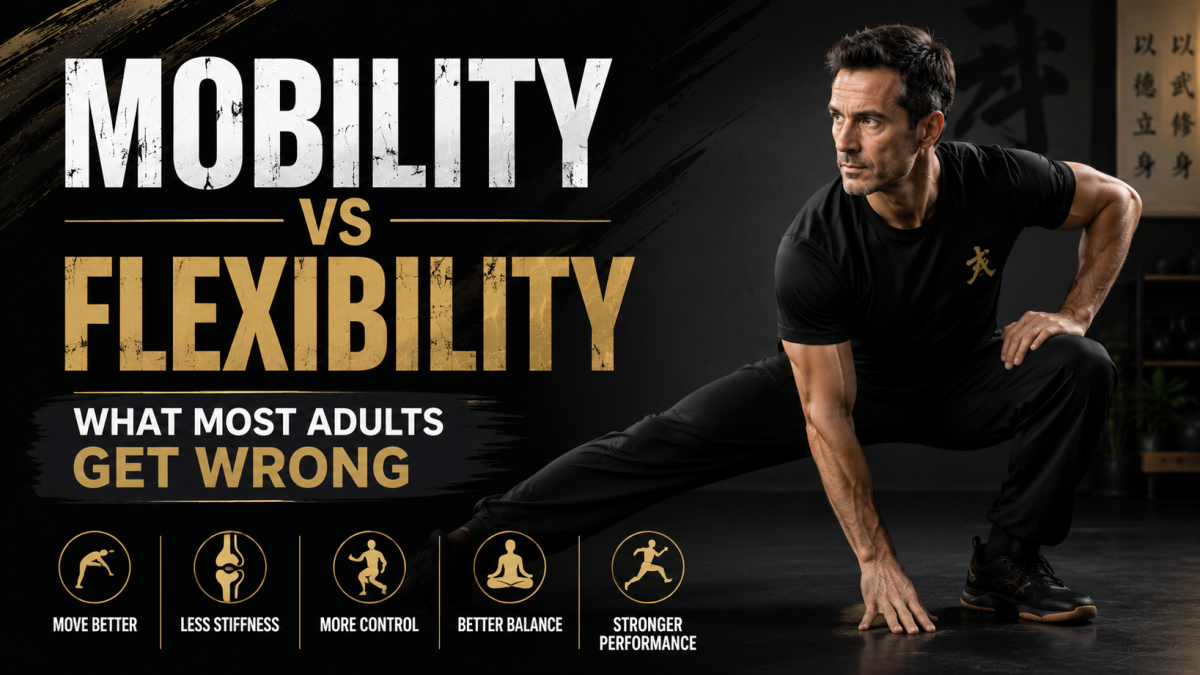
It explains how strength, mobility and flexibility work together to create a stronger, healthier and more capable body.
Mobility And Flexibility Are Not The Same Thing
One of the most common mistakes in fitness is using the words mobility and flexibility as if they mean exactly the same thing.
They don't.
In fact, understanding the difference can completely change the way you train.
Many people believe they need more stretching.
Sometimes they do.
But often the real problem is not flexibility.
It's mobility.
The good news is that once you understand the difference, you can train much more effectively.
What Is Flexibility?
Flexibility is your ability to lengthen a muscle or group of muscles.
In simple terms:
Flexibility is passive range of motion.
Examples include:
- touching your toes
- performing a hamstring stretch
- doing the splits
- stretching your shoulders
Flexibility is important because tight muscles can restrict movement.
However, flexibility alone does not guarantee good movement quality.
A person may be extremely flexible but still struggle with control, balance and strength.
What Is Mobility?
Mobility is your ability to actively move and control a joint through its available range of motion.
In simple terms:
Mobility is controlled range of motion.
Mobility requires:
- flexibility
- strength
- coordination
- stability
- balance
- motor control
For example:
Lifting your leg high and controlling it requires mobility.
Being able to place your leg high using your hands requires flexibility.
The difference is active control.
The Simple Example Most People Understand
Imagine two people.
Person A
Can sit comfortably in the splits.
However, they struggle to lift their leg under control.
Person B
Cannot do the splits.
But can lift their leg high using muscular control.
Person A has excellent flexibility.
Person B has better mobility.
The ideal situation is developing both.
Why Most Adults Focus On The Wrong Thing
When adults begin feeling stiff, the first thing they usually do is start stretching.
Stretching can help.
But stretching is not always the complete answer.
Many people are actually experiencing:
- weak stabilising muscles
- poor movement habits
- lack of strength through range
- poor joint control
This is why some people stretch every day but still feel stiff.
The body needs more than passive flexibility.
It needs active control.
Why Mobility Matters More As We Age
As we move through our thirties, forties and fifties, mobility becomes increasingly important.
Good mobility helps support:
- better posture
- healthier movement patterns
- confidence during movement
- balance
- coordination
- daily activities
Without mobility, everyday tasks can become more difficult.
Examples include:
- squatting down
- climbing stairs
- reaching overhead
- getting off the floor
- maintaining balance
This is one reason mobility is a major part of the WU Fit method.
Can You Be Flexible But Not Mobile?
Absolutely.
This is actually very common.
Many people have enough flexibility but lack:
- strength
- stability
- control
This means they cannot effectively use the movement they already have.
Think of mobility as flexibility plus control.
Without control, flexibility has limited value.
Can You Be Mobile But Not Flexible?
To a certain extent, yes.
Some people develop excellent movement control through strength training and movement practice.
However, flexibility limitations will eventually restrict mobility.
The goal is not choosing one over the other.
The goal is developing both together.
How WU Fit Approaches Mobility And Flexibility
At WU Fit Studio, we do not separate mobility and flexibility into completely different worlds.
We train them together.
Our Wushu-inspired approach combines:
- mobility drills
- flexibility training
- bodyweight strength
- balance work
- controlled movement
This helps create usable movement rather than simply chasing bigger stretches.
Learn more about the WU Fit approach:
👉 https://www.wufitstudio.com/blog/what-is-wushu-fitness
Common Signs You Need More Mobility
You may need more mobility if:
- you feel stiff despite stretching
- you struggle to squat comfortably
- your shoulders feel restricted
- your hips feel tight
- your balance is poor
- you feel unstable during movement
These are often signs that mobility should become a training priority.
Common Signs You Need More Flexibility
You may need more flexibility if:
- muscles feel constantly tight
- simple stretches feel difficult
- range of motion is restricted
- kicking movements feel impossible
- bending and reaching feel limited
In these cases, flexibility work can be extremely valuable.
The Biggest Mistake People Make
The biggest mistake is focusing exclusively on one side.
Some people only stretch.
Others only build strength.
Neither approach creates complete movement quality.
The most effective strategy is:
- Improve flexibility.
- Improve mobility.
- Build strength through your available range.
- Develop balance and control.
- Progress gradually.
This is exactly what we focus on inside WU Fit.
Mobility, Flexibility And Martial Arts Fitness
One reason martial arts-inspired training works so well is that it naturally develops multiple qualities at the same time.
A well-designed Wushu-inspired training session may include:
- mobility work
- flexibility work
- balance training
- coordination drills
- strength exercises
This helps create a more complete athlete and a more capable adult.
Learn more:
👉 https://www.wufitstudio.com/blog/wushu-training-strength-balance-flexibility
Common Beginner Mistakes
Stretching Without Strength
Range without control is limited.
Going Too Hard Too Soon
Mobility improves through consistency.
Ignoring Balance
Balance is a major component of movement quality.
Chasing Fast Results
Long-term progress produces lasting results.
Comparing Yourself To Advanced Athletes
Start where you are.
Progress from there.
Key Takeaways
- Mobility and flexibility are not the same thing.
- Flexibility is passive range of motion.
- Mobility is controlled range of motion.
- Most adults benefit from improving both.
- Mobility becomes increasingly important after 35.
- Strength, balance and coordination all contribute to good mobility.
- WU Fit combines mobility, flexibility and strength into one system.
Frequently Asked Questions
Which Is More Important: Mobility Or Flexibility?
Both matter.
Mobility usually has a greater impact on movement quality because it includes control.
Can Stretching Improve Mobility?
Sometimes.
However, mobility often requires strength and control work as well.
Why Do I Feel Tight Even Though I Stretch?
You may have mobility limitations rather than flexibility limitations.
Does Age Reduce Mobility?
Age itself is not the main problem.
Lack of movement and lack of training are usually bigger factors.
How Often Should I Train Mobility?
A little, done consistently, is often more effective than occasional intense sessions.
📚 Related Articles
🥋 New to WU Fit?
👉 What Is Wushu Fitness? A Beginner's Guide to Martial-Arts-Inspired Training
🤸 Improve Your Movement
👉 Mobility vs Flexibility: What Most Adults Get Wrong
👉 How Wushu-Based Training Improves Strength, Balance and Flexibility
💪 Fitness After 35
👉 Why High-Intensity Fitness Isn't Always The Best Choice After 35
👉 Fitness for Adults Over 40: How to Stay Strong, Mobile and Flexible
🔥 Looking For Something Different?
👉 A Better Alternative to Boring Gym Workouts
📖 Complete Guide
👉 The Complete Guide to Wushu Fitness for Strength, Mobility and Flexibility
🚀 Ready To Move Better?
🎁 Start With The Free 3-Day Flexibility Reset
Feel less stiff, move more freely, and experience Wushu-inspired training for yourself.
👉 Start Your Free 3-Day Flexibility Reset
📈 Want More Structure?
🔹 Join The 14-Day Flexibility & Mobility Starter Course
Build a stronger foundation with guided daily training designed to improve flexibility, mobility, balance, and movement confidence.
👉 Explore the 14-Day Starter Course
🥋 Ready For The Full WU Fit Experience?
Join The WU Fit Membership
Build:
💪 Strength
🤸 Mobility
🦵 Flexibility
⚖️ Balance
🎯 Body Control
🚀 Confidence
Through progressive Wushu-based training designed specifically for adults who want more than boring gym workouts.
👉 Discover the WU Fit Membership
💪 Build Strength. Improve Mobility. Move With Confidence.
🥋 WU Fit Studio
FREE
WU Fit Studio 3-Day Flexibility Reset
Feel Looser, Move Better, and Start Improving Flexibility in Just 3 Days
A free 3-day guided flexibility reset for adults 40+ who feel stiff, tight, or out of practice and want a simple way to start moving better.